
Every country now has an AI strategy. Fewer have an AI sovereignty strategy.
As the foundational AI-models grow in power at an exponential rate, the US and China are taking different strategic positions in their development, causing a near-existential crisis to the AI sovereignty of many countries around the world.
Over the past few months, I’ve been mapping how countries are positioning themselves around AI, and the pattern I keep coming back to is this: the important question is no longer simply whether a country can “adopt AI.” Almost every country can adopt AI. Cloud platforms, open-source models, consulting firms, and enterprise vendors have made adoption easier than ever. The harder question is whether a country can capture enough of the value created by AI, and retain enough strategic control to avoid becoming dependent on someone else’s stack.
That is the question behind this first article in The Sovereign AI Playbook.
I call it Minimum Viable Sovereignty.
The false binary: build everything or depend on everyone
A lot of the debate around sovereign AI gets stuck in a false binary.
On one side is the maximalist view: a country is only sovereign if it owns everything; chips, data centers, models, cloud, applications, talent pipelines, regulation, and capital.
On the other side is the market-absolutist view: sovereignty is unnecessary because countries can simply use the best global platforms available.
I don’t think either position is useful because very few countries can build everything domestically. Even the most advanced AI economies rely on global supply chains, foreign talent, cross-border capital, and international research networks.
But full dependence is not a strategy either. If the critical layers of the AI value chain are owned, governed, priced, and updated elsewhere, then national AI adoption can become a form of dependency. The country may get access to tools, but not necessarily to durable economic advantage.
So the practical question is not: Can we build everything ourselves?
The practical question is: Which layers must we control, which layers can we partner on, and where does dependency become value leakage?
That is where Minimum Viable Sovereignty begins.
What Minimum Viable Sovereignty means
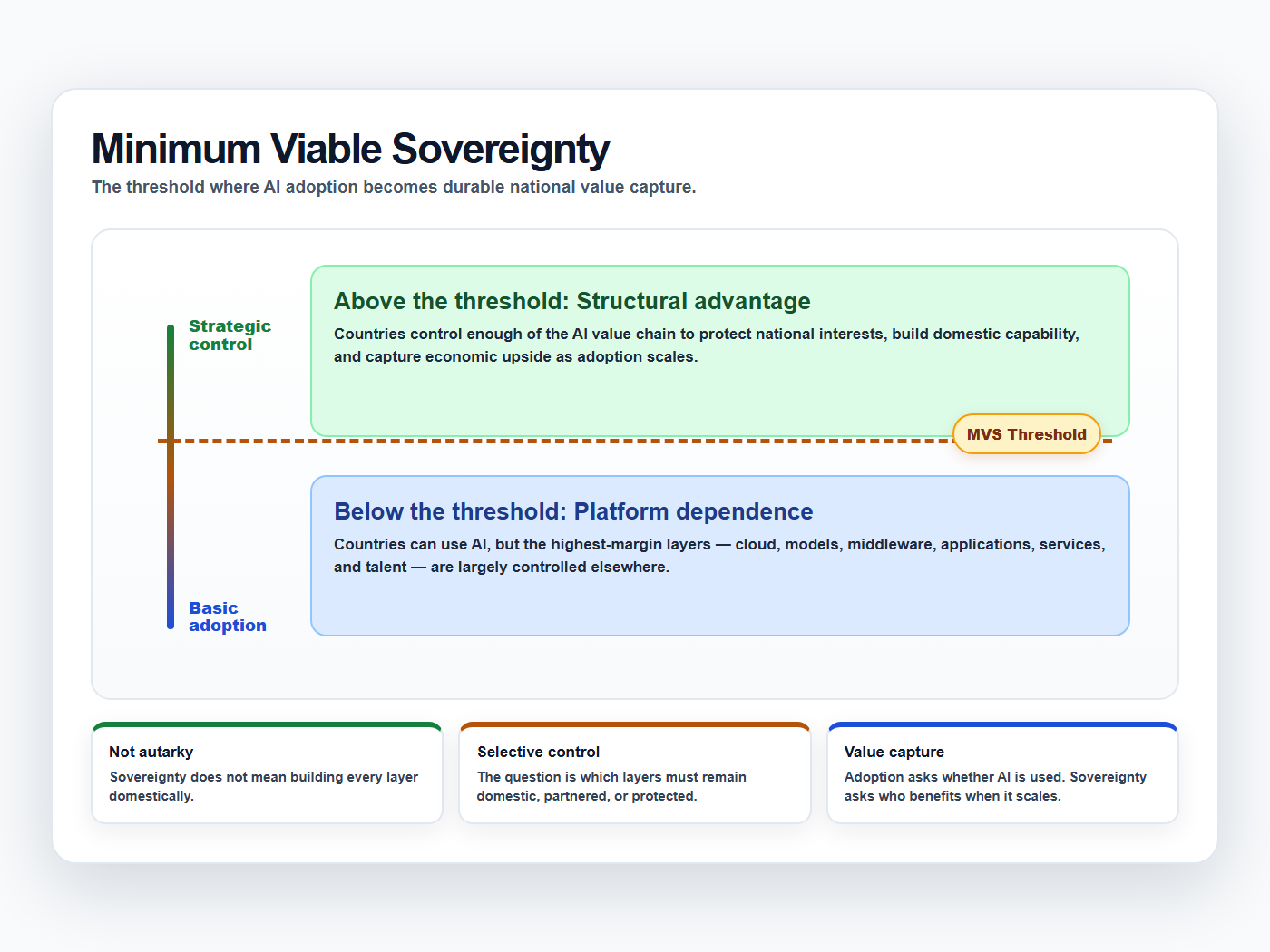
Minimum Viable Sovereignty is the threshold at which a country controls enough of the AI value chain to protect national interests, capture economic upside, and avoid becoming structurally dependent on foreign platforms.
It does not mean autarky, or rejecting foreign partners, and certainly does not mean every country should train a frontier foundation model from scratch.
It means a country has enough control across the right layers to make strategic choices.
At minimum, that usually requires five things:
1. Foundation capability: some domestic ability to operate, adapt, or influence core AI infrastructure and models.
2. Rules and governance: enough legal and institutional capacity to protect data, rights, and public trust.
3. Commercial adoption: real use cases in industry, not just pilot projects and press releases.
4. Ecosystem scaling: startups, integrators, middleware, services, talent, and applied research that turn infrastructure into products.
5. Gating constraints: energy, cooling, land, compute, capital, and skills managed as strategic bottlenecks rather than afterthoughts.
A country does not need to be world-class in all five. But if one or two are missing, sovereignty becomes fragile.
Sovereignty is becoming a value-capture problem
When AI becomes embedded in healthcare, finance, energy, education, logistics, defense, and public administration, it becomes part of the operating system of the economy.
In that world, value can leak in several ways:
Cloud spending flows to foreign hyperscalers.
Implementation work goes to global consulting firms.
Application-layer products are built elsewhere.
Domestic data improves foreign models more than domestic capability.
Talent migrates to countries with deeper AI ecosystems.
Local firms become customers of AI infrastructure rather than builders of AI advantage.
A simple way to think about it: Adoption tells you whether AI is being used. Sovereignty tells you who benefits when it scales.
Malaysia as an early threshold case
Malaysia is a useful example because it does not fit the simple story.
It is not a pure AI consumer. It has real foundations: data center momentum in Johor, semiconductor depth in Penang, energy and industrial adjacency through players like YTL Power, a national AI strategy, and domestic foundation-model activity through ILMU.
In the assessment work I’ve been doing, Malaysia scores as a Producer / Infrastructure archetype with a Composite Sovereignty Index of 71.2 out of 100. It is assessed as at the Minimum Viable Sovereignty threshold.
It means Malaysia has enough foundation to move. It is not merely telling an AI story. There is substance underneath: infrastructure, industrial adjacency, public trust, regional positioning, and early intelligence-production capability.
The assessment describes Malaysia as Lower-Stack-Dominant: strong in power, minerals, data centers, chips, and early models, but weaker in middleware, applications, and AI-native services.
That creates what I would call the “hollow middle.”
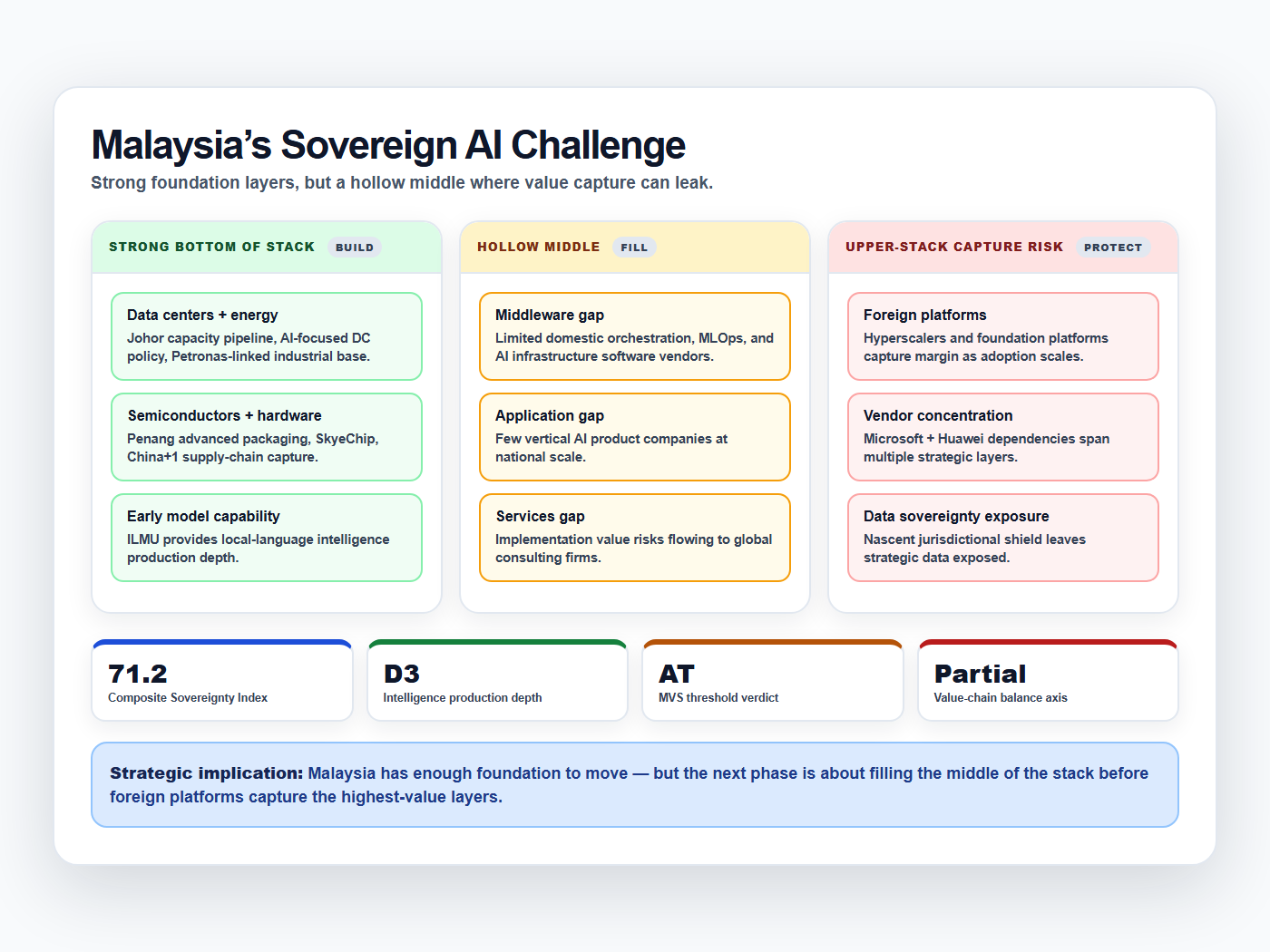
A country can build compute capacity and still lose value capture. It can train people and still see talent migrate. It can attract FDI and still have the highest-margin layers owned elsewhere. It can launch national AI programs and still depend on foreign orchestration tools, cloud platforms, and implementation partners. Malaysia’s problem is not simply whether it can build more data centers. It is whether it can convert infrastructure momentum into durable domestic advantage before physical and organizational bottlenecks tighten.
A recent report by the CNA Insider (Inside Malaysia’s Push to Build AI Factories), suggests the system is already running closer to physical limits than many investors or policymakers may assume. Johor is operating with roughly an 11% water reserve margin, and a typical 300MW data center can consume about twice the electricity and roughly one-third the water of a city of 300,000 people. That means the AI buildout is not just a capital story, but also utility physics story.
Malaysia’s case shows the nuance. The assessment flagged several bright spots:
Industrial adjacency: YTL Power, Penang semiconductors, minerals, power, and infrastructure give Malaysia real strategic leverage.
Regional interdependence: Johor-Singapore dynamics and ASEAN positioning create regional opportunity.
Public trust and alignment: Malaysia has enough institutional and political foundation to move faster than many peers.
But it also flagged constraints:
Value-chain hollowness in middleware, applications, and services.
Data sovereignty gaps, including exposure to foreign jurisdictional reach.
Demand-capacity ceilings, especially power, water, land, and data-center prioritization.
Vendor concentration risk, particularly where Microsoft and Huawei dependencies span multiple layers.
That combination is what makes Malaysia a threshold case.
A simple diagnostic for other countries
The Malaysia example points to a broader diagnostic that other countries can use.
Ask five questions:
1. Depth: Do we have any domestic capability in models, compute, data, or critical AI infrastructure?
2. Coverage: Are enough layers of the stack above minimum maturity, or are we dependent in too many places?
3. Balance: Are we strong only in infrastructure, or do we also have applications, services, and talent pipelines?
4. Capture resistance: When AI adoption scales, who captures the margin; domestic firms or foreign platforms?
5. Gating constraints: Are energy, cooling, capital, talent, and regulation being managed as strategic constraints?
A country that passes the first two but fails the third may look more sovereign than it is.
Why this matters beyond governments
This framework is not only for policymakers.
For companies, sovereign AI determines where future procurement, regulation, and partnership opportunities will emerge.
For investors, it helps identify where value is likely to accrue: infrastructure, middleware, vertical applications, services, talent platforms, or national champions.
For universities and talent systems, it clarifies which capabilities matter most if a country wants to move from adoption to production.
For boards, it reframes AI risk. The question is not only whether the company is adopting AI, but whether its AI dependencies create strategic exposure. Foundational model companies like Anthropic have disrupted their customers like Figma and Cursor, by training their models with their data, and releasing competitive products in the market. This is forcing companies to move towards customizing open-models that run on-prem or on trusted hosting sites.
Not every country needs to become an AI superpower. But every country needs to know where it must be sovereign enough.
What comes next
This is the starting point for the series.
In future pieces, I’ll use this frame to look at country cases and strategic patterns: threshold countries, trusted hubs, infrastructure states, producer economies, and countries at risk of sovereignty capture.
Subscribe if you want the next pieces in this series; country case studies, strategy frameworks, and practical maps for sovereign AI value capture.
This article is part of Frontier Signals: innovation, capital, and strategy at the edge of structural change.